LESSON 7 POLYNOMIALS

GOOD MORNING STUDENTS
yesterdays ' learning outcomes were:
I will be able to factorize polynomials by using
Todays learning outcomes I will be able to
find the value of "k"
factorise a quadratic polynomial (splitting the middle term)
factorise a cubic polynomial
AQAD
1) Find the remainder when x4+x3-2x2+x+1 is divided by x-1
a)1
b)5
c)2
d)3
FEW INSTRUCTIONS
The content in BLUE have to be written in the register as cw.
NOW LETS SOLVE Question 3.(EX 2.4)
Find the value of k, if x- 1 is a factor of p(x) in each of the following cases:
(ii)
(iv)
Solution LETS SOLVE (ii)
(ii) If x- 1 is a factor of polynomial
, then (USING FACTOR THEOREM)
So, value of k is .
(iv) If x- 1 is a factor of polynomial
, then
So, value of k is
Lets recall factorising quadratic polynomial by splitting the middle term
.CLICK THE GIVEN LINK FOR FACTORISATION OF QUADRATIC POLYNOMIAL
factorise quadratic polynomial
LETS TAKE AN EXAMPLE ( TO FACTORISE)
Example 1 : 4x2 + 12x + 5
Solution: We have to find two numbers, whose
sum is 12 (middle term) and when
multiplied (first and last term) i.e. 4 X 5 we get 20
So these two numbers are -
10 + 2 = 12
10 X 2 = 20
Now we put both 10 and 2 numbers in the middle term of 12x and we get
∴ 4x2 + 12x + 5
= 4x2 + 10x + 2x + 5
or 2x(2x + 5) + 1(2x + 5)
or (2x + 5)(2x + 1)
Try 4x2 + 8x - 5 (CW) Ans ((2x + 5)(2x - 1)
solve Q3 of ex 2.4
Question 4
Factorise:
(i)
lets solve
Solution
Here we would be using splitting the middle term to factorise the polynomial
To factorise , we should write b as the sum of two numbers whose product is ac
(i)
Here a=12, c=1 and b=7 So ,
(iv)
Here a=3, c=-4 and b=-1 So, ,
Lets see the video how to factorise cubic polynomial. click 👇
Factorise:
(i)
Solution
These are cubic polynomials and can be factorized using combination of long division method , remainder theorem and split middle term method
(i) Let
STEP 1 Factors of 2 are ±1 and ± 2
STEP 2 By trial method, we find that
STEP 3:- So,(x+1) is factor of p(x)
. STEP 4 :-Now using the Long division method , we can find the quotient as
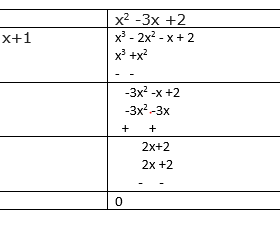
STEP 5 :- Now,
Factorizing the second part by split middle term method
Q5 (ii)
LETS SEE( ii) PART TOO
(ii) Let
Factors of 5 are ±1 and ±5
By trial method, we find that
So,(x-5) is factor of p(x)
Now using the Long division method , we can find the quotient as
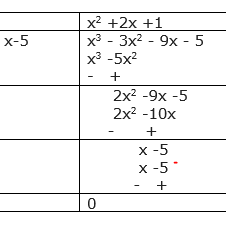
Now,
Factorizing the second part by split middle term method
HOME WORK remaining parts
(iii)
(iv)
I would encourage the students to try and then check your answer.
(iii) Let
Factors of 20 are ±1, ±2, ±4, ±5, ±10 and ±20
By trial method, we find that
So,(x+1) is factor ofp(x)
Now using the Long division method , we can find the quotient as
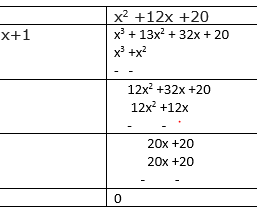
Now, Dividend = Divisor \times Quotient+ Remainder
Factorizing the second part by split middle term method
(iv) Let
Factors of ab = 2 \times (-1) = -2 are ±1 and ±2
By trial method, we find that
So,(y-1) is factor of p(y)
Now using the Long division method , we can find the quotient as
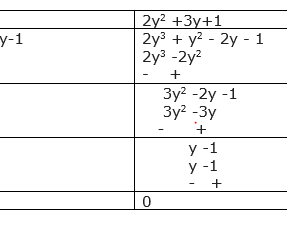
Now,
Factorizing the second part by split middle term method

HOMEWORK
I would encourage the students to try and then check your answer.
Factorize the following
- 3x3 –x2-3x+1
- x3-23x2+142x-12
a) )(3x-1)(x-1)(x+1)
b)(x-1)(x-10)(x-12)
AQAD Solution ( c)
Q3 solution
(i) If x- 1 is a factor of polynomial , then
So, value of k is -2.
(iii) If x- 1 is a factor of polynomial , then
So, value of k is
Here a=2, c=3 and b=7 So ,
(iii)
Here a=6, c=-6 and b=5 So, ,


No comments:
Post a Comment