Friday, May 15, 2020

POLYNOMIALS ( LECTURE 7)

LESSON 7 POLYNOMIALS


GOOD MORNING STUDENTS


yesterdays ' learning outcomes were:


I will be able to factorize polynomials by using

Todays learning outcomes  I will be able to 
 find the value of "k" 
factorise  a quadratic polynomial (splitting the middle term)
factorise a cubic polynomial

AQAD
1) Find the remainder  when x4+x3-2x2+x+1 is divided by x-1
 a)1
b)5
c)2
d)3


FEW INSTRUCTIONS
 The content in BLUE have to be written in the register as cw.


NOW LETS SOLVE Question 3.(EX 2.4)
Find the value of k, if x- 1 is a factor of p(x) in each of the following cases:

(ii)p(x)=2x2+kx+2
p(x)=kx22
(iv)p(x)=kx23x+k
Solution LETS  SOLVE (ii) 

(ii) If x- 1 is a factor of polynomial 

p(x)=2x2+kx+2, then (USING FACTOR THEOREM) 
p(1)=0
2(1)2+k(1)+2=0
k=22=(2+2)
So, value of k is (2+2).


(iv) If x- 1 is a factor of polynomial 
p(x)=kx23x+k, then
p(1)=0
k(1)2+3(1)+k=0
k3+k=0
k=32
So, value of k is 32


 Lets recall factorising quadratic polynomial by splitting the middle term


 .CLICK THE GIVEN LINK FOR  FACTORISATION OF QUADRATIC POLYNOMIAL


factorise quadratic polynomial


 LETS TAKE AN  EXAMPLE  ( TO  FACTORISE)  
Example 1 : 4x2 + 12x + 5
Solution: We have to find two numbers, whose
sum is 12 (middle term) and when
multiplied (first and last term) i.e. 4 X 5 we get 20

So these two numbers are -
10 + 2 = 12
10 X 2 = 20

Now we put both 10 and 2 numbers in the middle term of 12x and we get

∴ 4x2 + 12x + 5
 = 4x2 + 10x + 2x + 5
or 2x(2x + 5) + 1(2x + 5)
or (2x + 5)(2x + 1)

Try       4x2 + 8x - 5  (CW)         Ans ((2x + 5)(2x - 1)


solve Q3 of ex 2.4
Question 4
Factorise:
(i) 12x2+7x+1

lets solve 
Solution
Here we would be using splitting the middle term to factorise the polynomial
To factorise ax2+bx+c, we should write b as the sum of two numbers whose product is ac
(i) 12x2+7x+1
Here a=12, c=1 and b=7 So b=7=3+4 ,ac=12×1=12=3×4


12x2+7x+1
=12x2+4x+3x+1
=4x(3x+1)+1(3x+1)
=(3x+1)(4x+1)


(iv) 3x2x4
Here a=3, c=-4 and b=-1 So, b=1=4+3ac=3×(4)=12=(4)×3
=3x24x+3x4
=x(3x4)+1(3x4)
=(3x4)(
  Lets see the video how to factorise cubic polynomial. click πŸ‘‡ 


Factorise:

(i) x32x2x+2


Solution
These are cubic polynomials and can be factorized using combination of long division method , remainder theorem and split middle term method
(i) Let p(x)=x32x2x+2

STEP 1       Factors of 2 are ±1 and ± 2


STEP 2       By trial method, we find that

p(1)=(1)32(1)2(1)+2=0(
p(1)=(1)32(1)2(1)+2=0
STEP 3:-   So,(x+1) is factor of p(x)

. STEP 4  :-Now using the Long division method , we can find the quotient as
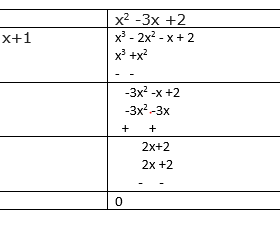
NCERT Solutions for Class 9 Maths Chapter 2 Polynomial Exercise 2.4 Question 5 (i)
STEP 5 :-  Now, Dividend=Divisor×Quotient+Remainder
x32x2x+2=(x+1)(x23x+2)

Factorizing the second part by split middle term method

=(x+1)(x2x2x+2)
=(x+1)[x(x1)2(x1)]
=(x+1)(x1)(x+2)

Q5 (ii) x33x29x5
LETS  SEE( ii) PART TOO 


(ii) Let 

p(x)=x33x29x5
Factors of 5 are ±1 and ±5
By trial method, we find that
p(5)=533×529×55=0
So,(x-5) is factor of p(x)
Now using the Long division method , we can find the quotient as
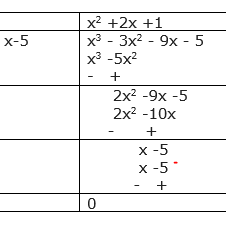
NCERT Solutions for Class 9 Maths Chapter 2 Polynomial Exercise 2.4 Question 5 (ii)
Now, Dividend=Divisor×Quotient+Remainder
x33x29x5=(x5)(x2+2x+1)
Factorizing the second part by split middle term method
=(x5)(x2+x+x+1)
=(x5)x(x+1)+1(x+1)
=(x5)(x+1)(x+1)

HOME WORK  remaining parts 
(iii) x3+13x2+32x+20


(iv) 2y3+y22y1


I would encourage the students to try  and then check your answer.


(iii) Let p(x)=x3+13x2+32x+20
Factors of 20 are ±1, ±2, ±4, ±5, ±10 and ±20
By trial method, we find that
p(1)=(1)3+13(1)2+32(1)+20=0
So,(x+1) is factor ofp(x)
Now using the Long division method , we can find the quotient as
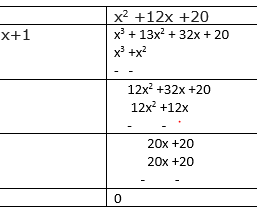
NCERT Solutions for Class 9 Maths Chapter 2 Polynomial Exercise 2.4 Question 5 (iii)
Now, Dividend = Divisor \times Quotient+ Remainder
x3+13x2+32x+20=(x+1)(x2+12x+20)
Factorizing the second part by split middle term method
=(x+1)(x2+2x+10x+20)
=(x5)[x(x+2)+10(x+2)]
=(x5)(x+2)(x+10)

(iv) Let p(y)=2y3+y22y1
Factors of ab = 2 \times (-1) = -2 are ±1 and ±2
By trial method, we find that
p(1)=2(1)3+(1)22(1)1=0
So,(y-1) is factor of p(y)
Now using the Long division method , we can find the quotient as
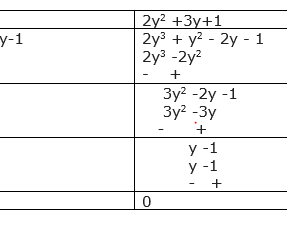
NCERT Solutions for Class 9 Maths Chapter 2 Polynomial Exercise 2.4 Question 5 (iv)
Now, 
2y3+y22y1=(y1)(2y2+3y+1)
Factorizing the second part by split middle term method
=(y1)(2y2+2y+y+1)
=(y1)[2y(y+1)+1(y+1)]
=(y1)(2y+1)(y+1)


 HOMEWORK  
I would encourage the students to try  and then check your answer.

Q3,Q4 (remaining parts )
Factorize the  following
  1. 3x3 –x2-3x+1
  2. x3-23x2+142x-12
Answer
a) )(3x-1)(x-1)(x+1)
b)(x-1)(x-10)(x-12)

   AQAD     Solution ( c)


Q3 solution
(i) If x- 1 is a factor of polynomial p(x)=x2+x+k, then
p(1)=0
(1)2+1+k=0
2+k=0
k=2

So, value of k is -2.
(iii) If x- 1 is a factor of polynomial p(x)=kx22x+1, then
p(1)=0
k(1)22(1)+1=0
k=21

So, value of k is 
2x2+7x+3
Here a=2, c=3 and b=7 So b=7=6+1 ,ac=2×3=6=6×1
=2x2+6x+x+3
=2x(x+3)+1(x+3)
=(x+3)(2x+1)

(iii) 6x2+5x6

Here a=6, c=-6 and b=5 So, b=5=9+(4) ,ac=6×(6)=36=9×(4)
=6x2+9x4x6
=3x(2x+3)2(2x+3

Thursday, May 14, 2020

POLYNOMIALS (LECTURE 6)

Good morning Boys!!!!!!!!!!!


Meeting ID  for class 9


In the previous class you have seen remainder theorem and how to apply the same .

Today' learning outcomes are:

I will be able to factorize polynomials by using the Factor Theorem.


Watch and comprehend the following video by clicking on the link below:


 Example 1

Example 2
 From text book

Let us consider factorising cubic polynomials. Here, the splitting method will not be appropriate to start with.
Example 3

Now we are able to solve EXERCISE 2.4


THAT'S  ALL FOR TODAY 

TRY AND SOLVE THESE SUMS BY YOURSELF 
THANK YOU AND HAVE A GREAT DAY


Wednesday, May 13, 2020

POLYNOMIALS ( LECTURE 5)

POLYNOMIALS


LESSON-5, DAY 3

GOOD MORNING EVERYONE!!


IMPORTANT e CIRCULAR
*We at St Columba's School, are ready to take the next step - and move towards using Google Classroom as a tool to enhance the teaching learning environment.

*This shift involves the school giving each student a unique email address, which he will need to setup ( the teachers will assist him in doing the same). This email will facilitate each student to interact with his teachers.

* The student should use this email ID only for:
-interacting with  teachers on school /subject related matters
-keep the words and expressions as he would- if he  were interacting with us as a Columban student
-use the facilities connected to this email ID only for google meets organised with the permission of a teacher 
-he should have a copy of the permission given ( when and by which teacher and for what purpose)
-do not access any of the other facilities connected with this email address unless he first seeks the permission of a teacher
(He should have a copy of the permission given - when and by which teacher and for what purpose).

*Please note that Google and St Columba's have legal obligations by giving you access to this email address and hence,
you will need to sign an agreement when creating this email ID. 

*Be informed that the history of use of this ID shall have a digital footprint !


Let us go through the guidelines for  the  blog once again:
·         Red,  is to be πŸ–‰ in your πŸ“–
·         Blue is to be πŸ‘€  by 
·         Green is to be πŸ’¬πŸ–‰πŸ“— for home work

  •      take your SET-A Mathematics πŸ“–
  •   OurπŸ“ƒ. It will be πŸ‘, if you use good presentation and cursive πŸ“ƒ
  •   Make a column on the RHS, if you need to do any rough work
  •     Leave  lines where you finished yesterday’s work and draw a horizontal line
  •     Write today's πŸ“†


LEARNING OUTCOMES Covered So far:

1. RECALL WHAT IS AN ALGEBRAIC EXPRESSION AND DEFINE POLYNOMIAL.
2. RECALL AND DEFINE TERMS AND COEFFICIENTS.
3. DEFINE DEGREE OF A POLYNOMIAL
4. CLASSIFY THE POLYNOMIALS ON THE BASIS OF NUMBER OF TERMS AND DEGREE.
5. COMPREHEND AND MEMORIZE ABOUT SOME SPECIAL POLYNOMIALS.
6. EVALUATE  VALUE OF A  POLYNOMIAL
7 .EVALUATE  ZERO  OF A  POLYNOMIAL.
8. Know that a polynomial can be ÷ by another polynomial.
9.Apply division process to polynomials.

10. Comprehend remainder theorem.


TODAY'S LEARNING OUTCOMES:

I WILL BE ABLE TO:
apply remainder theorem to calculate the remainder when a polynomial is ÷ by another polynomial.

Dear Students, a worksheet on Lines & Angles has  been sent through redox assignment tab to you. Please download using your student login on redox app or school website. Complete it by 18th May and then you may discuss the queries with me.


In the questions given below p(x) is divide by g(x). Q1 & Q5 are done as sample for you as an application of remainder theorem. Solve the other questions as per the steps given in the tableπŸ‘‡


HOME WORK:
REVISE CLASS WORK


No comments:

Tuesday, May 12, 2020

POLYNOMIALS (LECTURE 4)

POLYNOMIALS


LESSON-4, DAY 2

GOOD MORNING EVERYONE!!


Let us go through the guidelines for  the  blog once again:

·         Red,  is to be πŸ–‰ in your πŸ“–
·         Blue is to be πŸ‘€  by 
·         Green is to be πŸ’¬πŸ–‰πŸ“— for home work

  •      take your SET-A Mathematics πŸ“–
  •   OurπŸ“ƒ. It will be πŸ‘, if you use good presentation and cursive πŸ“ƒ
  •   Make a column on the RHS, if you need to do any rough work
  •     Leave  lines where you finished yesterday’s work and draw a horizontal line
  •     Write today's πŸ“†


LEARNING OUTCOMES Covered So far:

1. RECALL WHAT IS AN ALGEBRAIC EXPRESSION AND DEFINE POLYNOMIAL.
2. RECALL AND DEFINE TERMS AND COEFFICIENTS.
3. DEFINE DEGREE OF A POLYNOMIAL
4. CLASSIFY THE POLYNOMIALS ON THE BASIS OF NUMBER OF TERMS AND DEGREE.
5. COMPREHEND AND MEMORIZE ABOUT SOME SPECIAL POLYNOMIALS.
6. EVALUATE  VALUE OF A  POLYNOMIAL
7 .EVALUATE  ZERO  OF A  POLYNOMIAL.


TODAY'S LEARNING OUTCOMES:

I WILL BE ABLE TO:


1) know that a polynomial can be ÷ by another polynomial.

2) apply division process to polynomials.

3) comprehend remainder theorem.

4) apply remainder theorem to calculate the remainder when a polynomial is ÷ by another polynomial.


Q1) 10 - 6 = 4 , here 4 is known as a (remainder / sum)

Q2)  10 ÷ 2 = 5,here 5 is known as a (remainder/ quotient)

Q3) (10x - 1) - (3) = (10x -4), here (10x -4) is a _____

Q4) (2x + 4)  ÷ 2 =  POSSIBLE ? , please watch the following video (for just first 4min 45 seconds) to check


please observe the image given below

Q5) Divide (2x² + 4x - 7)  ÷ (x + 1)
A5) STEP-1: Write in division format 
       STEP-2: Divide 2x² by x {1st term of dividend by 1st term of divisor}
       STEP-3: Multiply (x + 1) by the answer from step-2
       STEP-4: Subtract & bring down -7{This forms the new dividend}
       STEP-5: Divide 2x by x {1st term of new dividend by 1st term of divisor}

       STEP-6: Multiply (x + 1) by the answer from step-5
       STEP-7: Subtract. The remainder is ____


The above process
gives us two OUTPUTS:
FIRST: The quotient
SECOND: The remainder
Please ➤πŸ‘‡


You heard this word "tedious", in the above audio.
Please write this new word in your diary with today's date:
TEDIOUS : means , too long, slow or dull

Cleaning of our rivers such as Yamuna & Ganga 
had become a tedious process, 
because, 
we as the citizens of India 
were not making full contributions to the process. 
We were still 
littering the rivers through our selfish acts. 
COVID-19 
has corrected this doing of ours.
Read about SDG-14 : Life below water 

Q6) 11 ÷ 2, gives, quotient  = ___, remainder = ___

Q7) In Q6, 11 = 2 × ___ + ___  {Hint: substitute quotient & remainder}


In the questions given below p(x) is divide by g(x). Q8 & Q12 are done as sample for you as an application of remainder theorem. Solve the other questions as per the steps given in the tableπŸ‘‡


      VERY IMPORTANT NOTE:
If the divisor is given as ( 2 + 3x),
Write as (3x + 2),
or
If the divisor is given as ( 2 - 3x),
Write as (-3x + 2),
before applying remainder theorem

HOME WORK:
Ex. 2.3- Q1,2 & 3


POLYNOMIALS ( TEST )

POLYNOMIALS LESSON-12, DAY 5 Please follow the steps given below to attempt the class test ...